

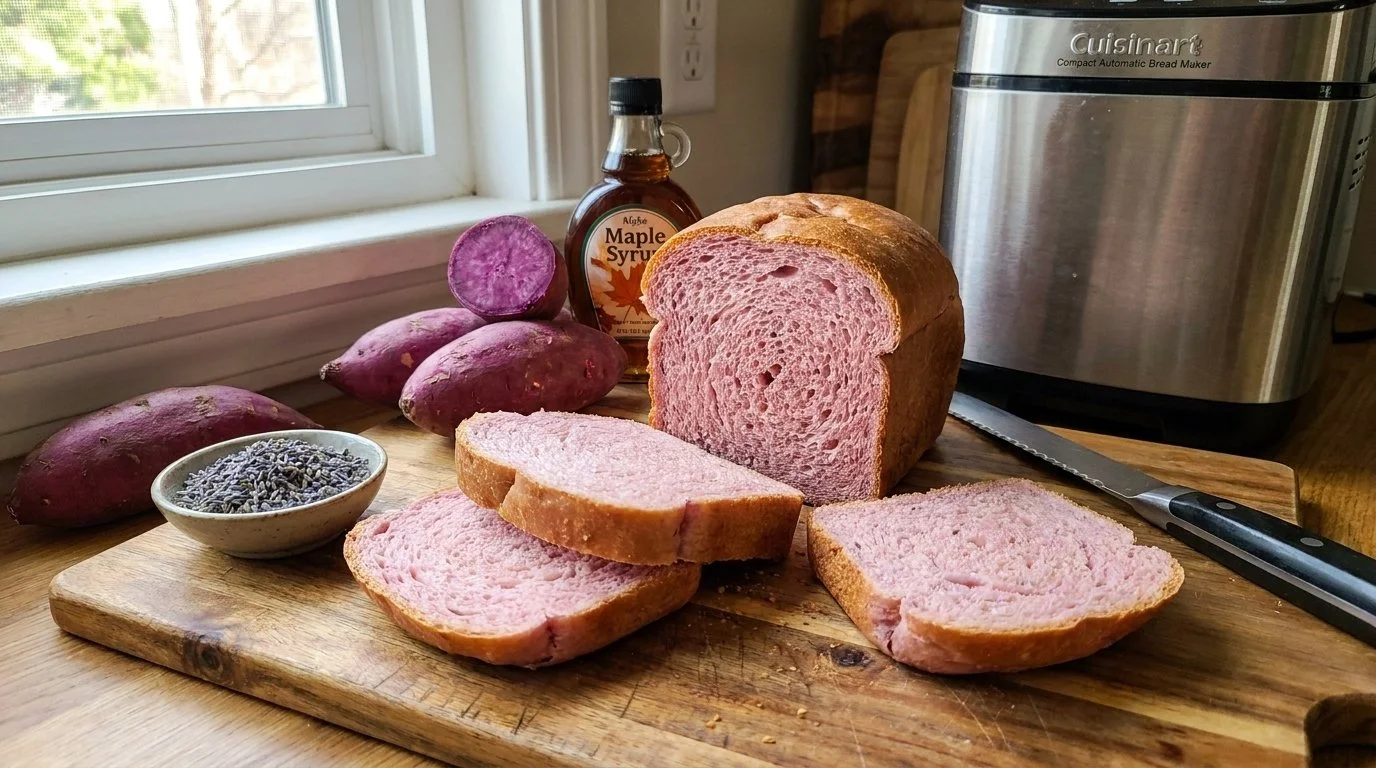
I thought it was gonna be purple!
Maple-Lavender Japanese Sweet Potato Bread Recipe
This post contains an affiliate link. I may earn a commission from qualifying purchases at no additional cost to you.
One of my favorite things about growing my own food is figuring out what to do with everything once it's harvested.
This time, I decided to turn some of my homegrown purple Japanese sweet potatoes into homemade bread.
And somehow, I ended up making pink bread!
I wanted something a little different from traditional sweet potato bread, so I experimented with maple syrup, culinary lavender, warm spices, and fresh sweet potato. I also wanted to make the process as simple as possible, so I pulled out my Cuisinart Compact Automatic Bread Maker and let it handle the mixing, kneading, rising, and baking.
The finished loaf had a beautiful golden crust and a soft rose-colored interior. It was denser than a typical sandwich bread, but it tasted good, looked beautiful, and gave me another delicious way to enjoy something I'd grown right in my backyard.
Here's how I made it.
Maple-Lavender Japanese Sweet Potato Bread
Yield: One 1½-pound loaf
Equipment: Cuisinart CBK-110 bread maker, microwave, and mixing bowl
Bread maker setting: Program #5, Sweet
Crust setting: Light
Ingredients
For the sweet potatoes and lavender milk
¾ cup (170 g) cooked, mashed purple Japanese sweet potato
¾ cup buttermilk or oat milk, for infusing
¼ teaspoon culinary lavender, food-grade
1 tablespoon maple syrup
2 tablespoons neutral oil
1 teaspoon vanilla bean paste (optional)
You'll measure out ⅔ cup (160 mL) of the infused milk after straining.
Dry ingredients
3¼ cups (390 g) bread flour
2 tablespoons brown sugar
½ teaspoon ground cinnamon
⅛ teaspoon ground cardamom (optional)
1 teaspoon salt
2 teaspoons instant or bread machine yeast
Step-by-Step Instructions
Step 1: Prepare the sweet potatoes
Wash your sweet potatoes thoroughly and pierce them several times with a fork.
Place them on a microwave-safe plate and microwave until completely tender, turning as needed. Cooking time will depend on their size.
Allow them to cool enough to handle, then remove the skins and mash the flesh until smooth.
Measure out ¾ cup (170 g) for the bread.
Tip: Make sure your sweet potatoes are thoroughly mashed. Large chunks can interfere with the texture of the finished loaf.
Step 2: Make the lavender-infused milk
Pour ¾ cup of your chosen milk into a microwave-safe measuring cup or bowl.
Warm it gently in the microwave, checking frequently, until warm but not boiling.
Add ¼ teaspoon of culinary lavender and allow it to steep for approximately 5 minutes.
Strain out the lavender flowers and allow the milk to cool until just lukewarm.
Measure out ⅔ cup (160 mL) of the infused milk for the recipe.
I used buttermilk for my loaf, which also added a slight tanginess to the finished bread.
Step 3: Load the bread maker
For my Cuisinart bread maker, I added the ingredients in the following order.
Wet ingredients first:
Lavender-infused milk, ⅔ cup
Mashed sweet potato, ¾ cup
Maple syrup, 1 tablespoon
Neutral oil, 2 tablespoons
Vanilla bean paste, if using
Dry ingredients next:
Bread flour, 390 g
Brown sugar, 2 tablespoons
Cinnamon, ½ teaspoon
Cardamom, if using
Salt, 1 teaspoon
Yeast last:
Make a small well in the flour, keeping it away from the wet ingredients, and add the 2 teaspoons of yeast.
Step 4: Set the bread maker
On my Cuisinart Compact Automatic Bread Maker, I selected:
Program: #5 Sweet
Loaf Size: 1½ pounds
Crust Color: Light
Press Start and let the machine do its thing!
The bread maker handles the kneading, rising, and baking, making this a convenient way to prepare homemade bread.
Step 5: Check the dough
After about 10–15 minutes of kneading, take a quick look at the dough.
It should begin forming a soft, slightly tacky ball.
If it looks overly wet and sticky, add bread flour one tablespoon at a time.
If it seems too dry or crumbly, add a little milk, also one tablespoon at a time.
Sweet potato moisture can vary, so small adjustments may be necessary.
Step 6: Cool and enjoy
Once the baking cycle finishes, carefully remove the bread pan using oven mitts.
Turn the loaf out onto a cooling rack and allow it to cool thoroughly before slicing.
This helps the crumb set and makes it easier to cut clean slices.
Then comes the fun part: seeing what color your sweet potatoes created!
So, Why Did My Purple Sweet Potato Bread Turn Pink?
I was expecting something a little more purple, but my finished loaf came out a beautiful rosy pink.
Purple sweet potatoes contain natural pigments called anthocyanins, which can change color depending on factors like acidity and heat.
Because I used buttermilk, which is acidic, that may have contributed to the pink color.
Whatever the exact combination of factors, I wasn't complaining. The color was gorgeous!
How Did It Taste?
The bread had a lightly sweet flavor, with maple, warm spices, and a gentle floral element from the lavender.
The texture was definitely on the denser side, rather than light and fluffy like traditional sandwich bread.
But that doesn't mean it wasn't delicious.
In fact, I think this bread would be especially good toasted with butter or used for something like French toast.
And because it's made with actual sweet potatoes, it has a character all its own.
A Few Tips Before You Bake
Use culinary lavender. Make sure you're using food-grade lavender and don't overdo it. A little goes a long way.
Measure your flour by weight. I recommend using 390 grams for the most consistent result.
Expect some color variation. Different sweet potato varieties, milk choices, and baking conditions can affect the final color.
Let your bread cool. Cutting into warm bread too early can make the interior seem gummy, especially with a moisture-rich ingredient like sweet potato.
Don't expect a super-light loaf. Sweet potato adds moisture and weight to the dough, making this a more substantial bread.
From My Backyard to My Bread Maker
This is exactly why I enjoy gardening and cooking from scratch.
There's something satisfying about planting something, watching it grow, harvesting it, and eventually turning it into something completely different in the kitchen.
I didn't set out specifically to make pink bread, but that's part of the fun of experimenting.
And now I have another way to use the Japanese sweet potatoes I've been growing at home.
A little gardening, a little creativity, and a bread maker that does the heavy lifting.
That's my kind of living well.
